

POLYTIVES BLOG

Reduce Gelation Time in PVC: Practical Example with a bFI Additive
Polytives shows how to reduce gelation time in PVC and provides insight into the first promising data.

Limits of the MFI Value: What It Doesn’t Show
Why a single measurement only partially reflects process capability in injection molding One value that gets cited often in the plastics industry is the melt mass-flow rate, or MFI — or its counterpart, the melt volume-flow rate, MVR. Both belong to the standard...
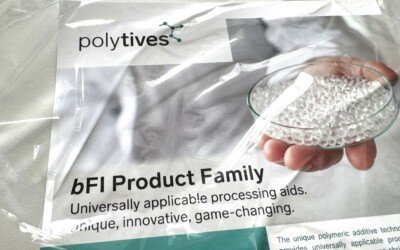
PFAS- and Silicone-Free Additives by Polytives: Safe, Efficient, Future-Proof
In plastics and film processing, per- and polyfluoroalkyl substances (PFAS) and silicones have long been part of the standard toolkit of process aids. A closer look at both substance groups shows why that's starting to change. Proven tools with well-known drawbacks As...

Prevent blooming
What blooming is, what causes it, and how to prevent blooming In plastics processing, a phenomenon often occurs that is frequently underestimated: blooming. This involves additives migrating from the interior of a plastic to its surface. Blooming manifests as...
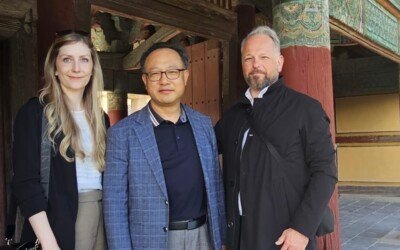
Trade Fairs, Pitches, Customer Visits: Polytives on the Move Across Two Continents
Over the past few months, we traveled across Asia and Europe to connect and engage at a wide variety of events. We had inspiring exchanges with industry experts, partners, and customers, all of whom brought their own visions, ideas, and challenges to the table....

Recycling plastics in cars
Recycling plastics in cars: Opportunities and Challenges of the EU End-of-Life Vehicles Regulation Plastics in Cars: A Boon for Design, a Challenge for the EU End-of-Life Vehicles Directive Plastics have been used in the automotive industry since the 1960s. While...
PMMA weathering stability – efficient processing without compromise
In a previous article, we explained what xenon tests are, why they are indispensable for plastics, and which standards such as DIN EN ISO 4892-2 underpin them. This post follows up on that with a concrete example of practical application from Polytives and Röhm. It...
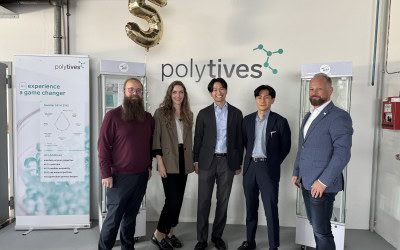
Polytives Looking Back at 2025
Anniversary, Innovation, and Global Presence: Looking back at 2025 As we look back on the past months, we are filled with pride and gratitude. This year has been rich in meaningful moments and progress: we reaffirmed our high quality standards, successfully...

Polymer additives for PMMA optimisation
How polymer additives such as bFI A 3745 are revolutionising PMMA processing: shorter cycle times, lower temperatures and stable optical properties for more efficient and sustainable plastics production.
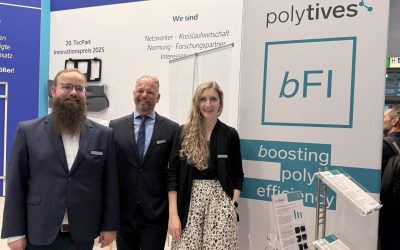
Polytives at K 2025 – the world’s no. 1 trade fair for plastics and rubber
Looking Back at K 2025: Our Journey in Düsseldorf After an intense week full of inspiring talks, new connections, and shared visions for a more sustainable plastics industry, we’re taking a moment to look back at our experience with Polytives at K 2025 in Düsseldorf....
How polymer additives can improve the processing of PMMA
The plastics industry is undergoing a transformation – driven by sustainability, energy efficiency & material innovation. Polymeric additives

Peroxides and antioxidants in plastics
In plastics processing, additives are generally indispensable for controlling processability and material properties. Two well-known classes of additives are peroxides and antioxidants in plastics – both fulfill essential but contradictory tasks. Their combined use is therefore problematic.