

Why a single measurement only partially reflects process capability in injection molding
One value that gets cited often in the plastics industry is the melt mass-flow rate, or MFI — or its counterpart, the melt volume-flow rate, MVR. Both belong to the standard toolkit for assessing how a material flows. And yes, they’re genuinely useful for a quick incoming goods inspection: the plastic is heated to a defined temperature, loaded with a fixed weight, and pushed through a small die. Whatever comes out in ten minutes is measured — and that gives you a comparative value that reliably picks up on batch-to-batch variation.
The trouble is, that’s exactly where the limits of the MFI value begin.
Plastics are, as a rule, shear-thinning when they flow. Put simply: the more shear, the thinner the melt becomes. How much shear actually occurs depends heavily on the processing method. Extrusion tends to operate in the lower shear range, while injection molding works at much higher shear rates. This shows up clearly in a typical viscosity curve — take PMMA at 260 °C, for example: at a low shear rate, viscosity sits above 250, but at nearly 6,000 1/s it drops below 40. Same material, two completely different flow states, depending on where you measure.
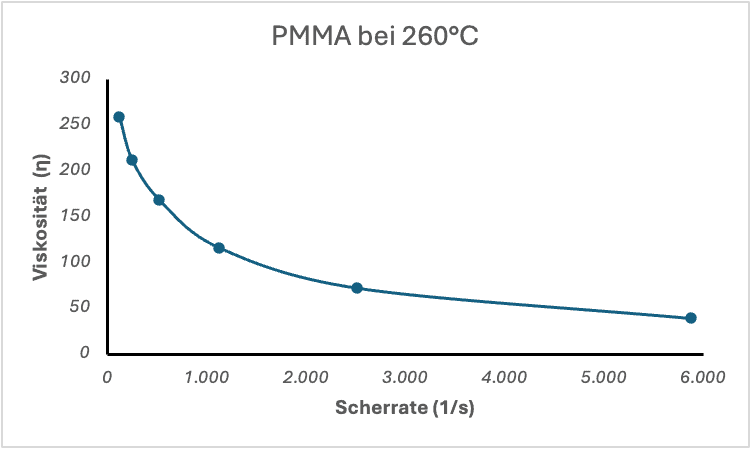
DURCH ENGLISCHE VARIANTE ERSETZEN
Limits of the MFI Value in the Injection Molding Process
And this is where the real problem lies: the test weight in the MFI test generates a fixed, but comparatively low, shear force. So the measurement only captures the lower shear range — precisely where viscosity is naturally high. For the real conditions in injection molding, where shear rates run far higher, this value simply doesn’t say much. You get a number, but no reliable indication of how the material actually behaves in the process.
Anyone who genuinely wants to assess a material’s process capability can hardly avoid producing a flow spiral. It’s made under real conditions, directly on the injection molding machine, and the flow length can be read off precisely on a scale. Because the actual process parameters are factored in here, the result is far more meaningful than a plain MFI value.
Just how big the difference can be is shown by one example that surprises a lot of people: even a 5% change in the MFI can translate into a flow-length improvement of up to 50% on the flow spiral. In the end, the MFI value is just a single point on an asymptotic curve. Nothing more — but nothing less, either.
Why does this topic matter to us? The bFI technology delivers a genuine flow boost — without compromising mechanical properties. Yet this benefit often isn’t fully captured by the MFI value alone, and the advantage for our customers, despite its significance, lies hidden within these physical characteristics. So please don’t hesitate to reach out to us at any time — let’s start the conversation!
Recent Comments