

PVC is a material with demanding melt properties. Processing it requires specialized equipment, above all adapted screws in the extrusion process. The reason: at excessive shear, hydrogen chloride gas can form, which attacks screws and machine components. Since this equipment is expensive, high utilization plays a decisive economic role. Shear rates can be lowered with flow improvers such as polyolefin waxes or stearates, but the possible reduction in production time is only minor.
Why Gelation Time Is the Decisive Factor
A key factor is gelation, a sub-process of PVC melting. Gelation time determines how quickly the extruded material, such as a window profile, can be hauled off. If it is too long, the process becomes unnecessarily expensive. If the material is hauled off before the gelation time has been reached, it may, in the worst case, fail to hold its shape.
Additives That Significantly Reduce Gelation Time in PVC
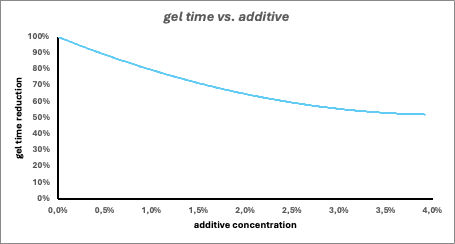
In an trial conducted by a customer, we examined the process with regard to the effect of our additive technology, which can significantly reduce gelation time in PVC. It was important to us that hydrogen chloride formation does not increase and that the mechanical properties of the material remain unchanged. In addition, the additives were compared with commercially available waxes and oils. Here, the additive bFI A 3745 performed convincingly.
A Glimpse of the Results
- Adding 0.8 wt% of the bFI additive reduced gelation time by 15%
- Adding 1.6 wt% of the bFI additive reduced gelation time by more than 30%
In addition, the final torque was reduced.
Conclusion
With the Polytives additive, PVC can be produced in less time and therefore more energy-efficiently. This saves costs and improves equipment utilization. Reducing the gelation time of PVC therefore pays off in several ways.
Curious to learn more? If you would like to find out more about our new additives, visit us at Fakuma in Friedrichshafen from October 12 to 16, booth A5-5104!
Recent Comments